
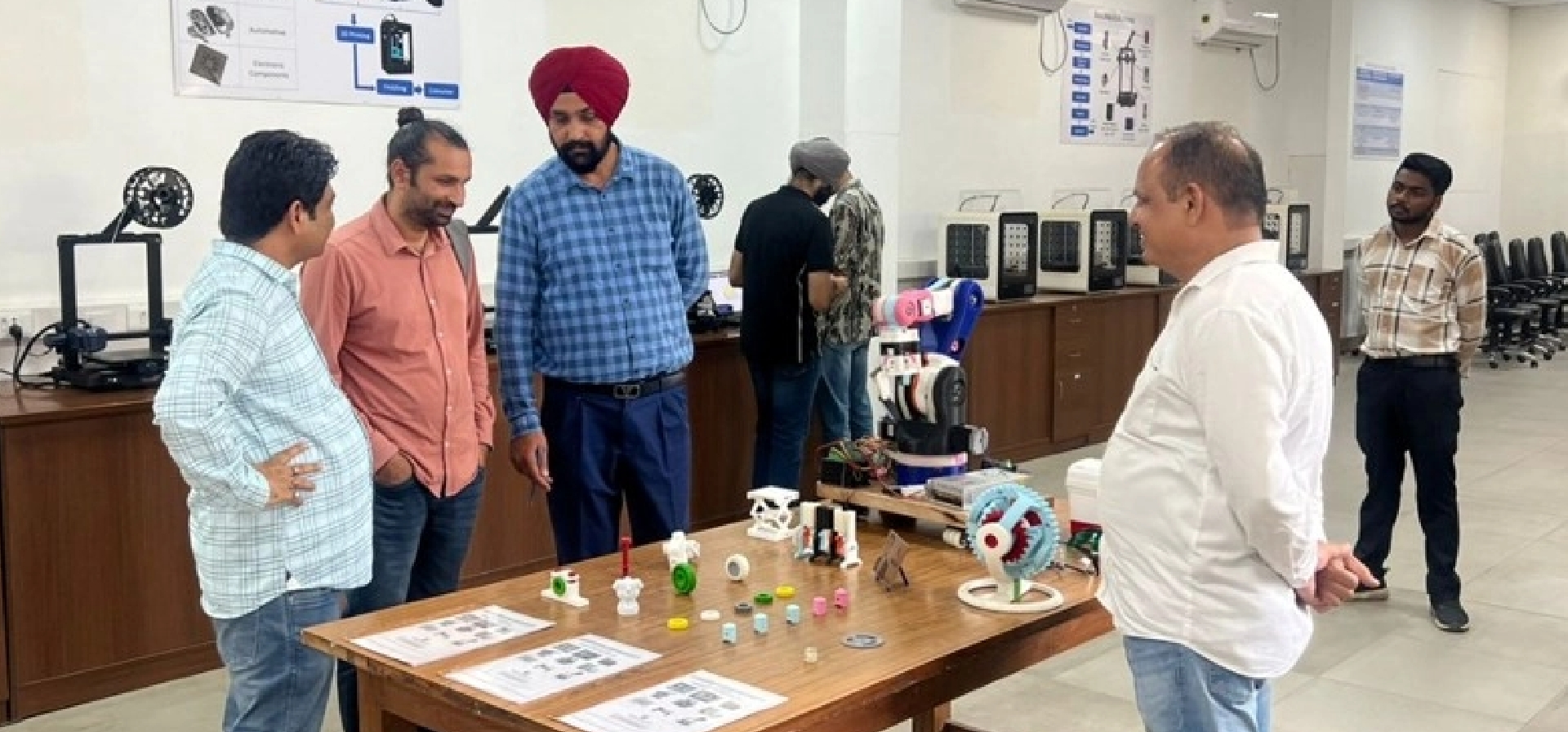

| Make / No. of Machines | Anycubic / 10 |
|---|---|
| Model | Kobra neo |
| Title of the related experiment: |
|
| A brief explanation of the usage of the said equipment | The machine is utilized for developing test samples and functional prototypes of PLA, ABS, PC, TPU, PLA(CF), PETG etc. The students learn to operate the machines and develop their prototypes after undergoing experiments which expose them to different problem areas related to plastic manufacturing like shrinkage, surface roughness, edge profiles, part deposition orientation and slicing of CAD models. They are also exposed to the effects of different process parameters like layer thickness, hatching patterns, nozzle temperature, part bed temperature, raster angle etc. on the developed part. With this setup, students should be able to comprehend the effect of different process parameters on: |
| Make / No. of Machines | Anycubic / 2 |
|---|---|
| Model | Kobra neo2 |
| Title of the related experiment: |
|
| A brief explanation of the usage of the said equipment | The machine is utilized for developing test samples and functional prototypes of liquid photosensitive resin. The students learn to operate the machines and develop their prototypes after undergoing experiments which expose them to different problem areas related to plastic manufacturing like shrinkage, surface roughness, edge profiles, part deposition orientation and slicing of CAD models. They are also exposed to the effects of different process parameters like layer thickness, in-fill percentage, exposure time etc. on the developed part. With this setup, students should be able to comprehend the effect of different process parameters on: |
| Make / No. of Machines | FLSUN / 3 |
|---|---|
| Model | Q5 |
| Title of the related experiment: |
|
| A brief explanation of the usage of the said equipment | The machine is utilized for developing test samples and functional prototypes of liquid photosensitive resin. The students learn to operate the machines and develop their prototypes after undergoing experiments which expose them to different problem areas related to plastic manufacturing like shrinkage, surface roughness, edge profiles, part deposition orientation and slicing of CAD models. They are also exposed to the effects of different process parameters like layer thickness, in-fill percentage, exposure time etc. on the developed part. With this setup, students should be able to comprehend the effect of different process parameters on: |
| Make / No. of Machines | Creality / 1 |
|---|---|
| Model | Cr 200B Pro |
| Title of the related experiment: |
|
| A brief explanation of the usage of the said equipment | The machine is utilized for developing test samples and functional prototypes of liquid photosensitive resin. The students learn to operate the machines and develop their prototypes after undergoing experiments which expose them to different problem areas related to plastic manufacturing like shrinkage, surface roughness, edge profiles, part deposition orientation and slicing of CAD models. They are also exposed to the effects of different process parameters like layer thickness, in-fill percentage, exposure time etc. on the developed part. With this setup, students should be able to comprehend the effect of different process parameters on: |
| Make / No. of Machines | Snapmaker / 1 |
|---|---|
| Model | SNP 3in1 |
| Title of the related experiment: | Easily swaps between three distinct toolheads for 3D printing, laser engraving, and CNC carving. |
| A brief explanation of the usage of the said equipment | Designed for versatile workshop projects, this machine easily swaps between three distinct toolheads for 3D printing, laser engraving, and CNC carving. Simply select and install the appropriate toolhead based on your project, adjust the required settings, and start creating. Whether you're producing detailed 3D models, engraving precise designs, or carving patterns into wood and other materials, the interchangeable toolheads provide a convenient all-in-one solution for a wide range of creative and fabrication tasks. |
| Make / No. of Machines | Rotrics / 1 |
|---|---|
| Model | Dex-arm |
| Title of the related experiment: | DexArm is a 4-axis desktop robot arm with modular design and 0.05mm high repeatability. It can be easily turned into a desktop plotter, laser engraver, and 3D printer. |
| A brief explanation of the usage of the said equipment | DexArm can be used for a wide range of desktop applications, including drawing, plotting, laser engraving, 3D printing, pick-and-place operations, and small-scale prototyping. Its modular design allows users to easily change toolheads and adapt the robot for different tasks. It is also useful for STEM education, robotics projects, programming practice, and learning about automation and CNC technology. With its high repeatability and compact design, DexArm is suitable for both educational and creative applications. |
| Make / No. of Machines | Creality / 5 |
|---|---|
| Model | Cr 200B |
| Title of the related experiment: |
|
| A brief explanation of the usage of the said equipment | The machine is utilized for developing test samples and functional prototypes of liquid photosensitive resin. The students learn to operate the machines and develop their prototypes after undergoing experiments which expose them to different problem areas related to plastic manufacturing like shrinkage, surface roughness, edge profiles, part deposition orientation and slicing of CAD models. They are also exposed to the effects of different process parameters like layer thickness, in-fill percentage, exposure time etc. on the developed part. With this setup, students should be able to comprehend the effect of different process parameters on: |
| Make / No. of Machines | Creality / 1 |
|---|---|
| Model | UW-03 Washing/Curing Machine |
| Title of the related experiment: | UW-03 Washing and curing module use for clean and curing a resin based component |
| A brief explanation of the usage of the said equipment | An SLA resin-based parts washing and curing module is used for the post-processing of 3D-printed resin parts. After printing, the parts are placed in the washing chamber to remove uncured resin from their surfaces using a suitable cleaning solution such as isopropyl alcohol (IPA) or water, depending on the resin type. Once washed and dried, the parts are transferred to the curing chamber, where controlled UV light further hardens the resin and improves the part's strength, surface finish, and stability. This combined system simplifies and standardizes the post-processing process by integrating washing and UV curing into a single module. |